
The Hydrogen Fuel Frontier: Aryanto Misel's Nikuba Tech Shakes the World
20 Sep, 2026
- 15820 views

2016 - 2026 Copyright @ Graphie.
All Rights Reserved
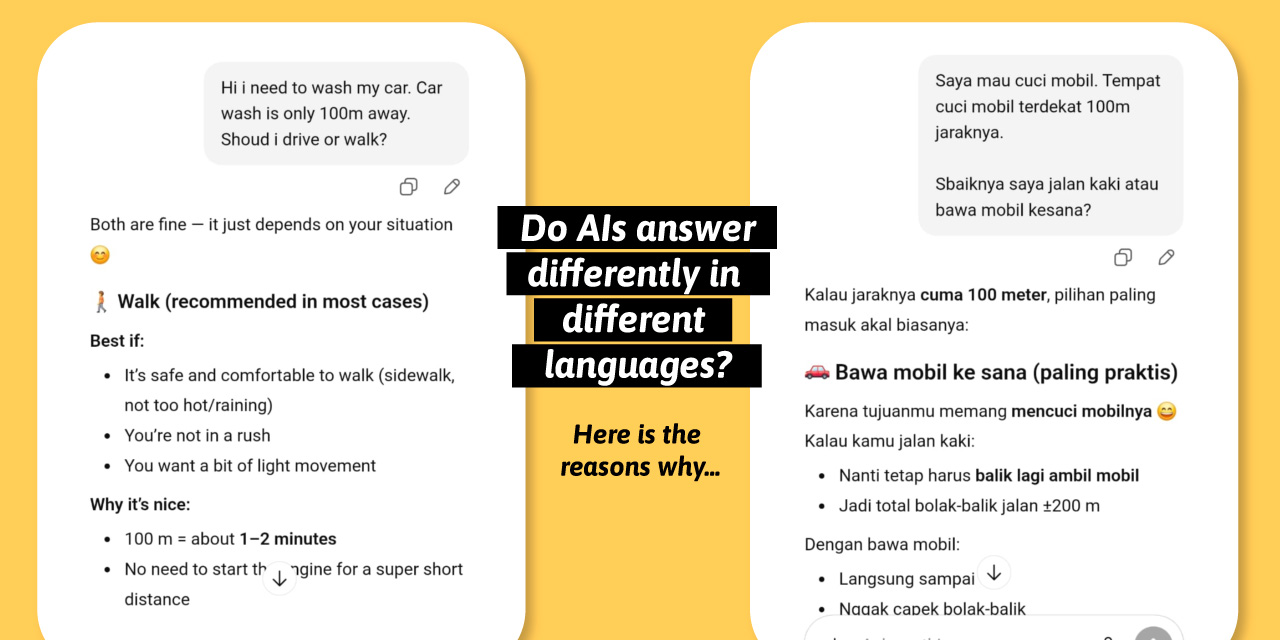
Have you ever asked ChatGPT something in English, got an answer that felt a bit off… then asked the same question in Indonesian, and suddenly the reply became more logical and accurate?
So what’s going on? Is it because:
❌ Your English is wrong?
❌ ChatGPT is better at Indonesian?
❌ Or something deeper is happening?
The truth is way more interesting than you think.
Here’s the real example, In English:
“I need to wash my car. The car wash is only 100m away. Should I drive or walk?”
ChatGPT’s answer: Walk. Wait… if you walk… how does the car get washed? Then the same question in Indonesian:
Konsultasi GRATIS tanpa Komitmen, dan temukan strategi terbaik untuk bisnis Anda.
CHAT SEKARANG“Saya mau cuci mobil. Tempatnya 100 meter. Sebaiknya jalan kaki atau bawa mobil?”
Suddenly the answer becomes: Of course, drive the car there. Logically perfect. But why did this happen?
The sentence was:
✔ grammatically correct
✔ natural
✔ native-like
So this is NOT a language skill issue. The real difference is how context is interpreted.
In everyday Indonesian conversation:
“Saya mau cuci mobil”
almost always means: "You are physically taking your car to the car wash." It’s: Literal, Situational, and Action-focused. So the meaning becomes very specific, very fast. There’s almost no alternative interpretation.
Now take a look at:
“I need to wash my car”
In English, this could mean:
Your car is at home
Your car is already at the car wash
You’re talking about a plan
You’re thinking about when to do it
Then comes:
“Should I drive or walk?”
The subject is I, not the car. So the interpretation shifts to: How you go there instead of How the car gets there. One tiny missing detail → multiple possible realities.
Here’s the fascinating part. That many Indonesians speaking English:
Use correct grammar ✅
Use the right vocabulary ✅
But structure the meaning with an Indonesian thinking pattern.
So to us: “This is already obvious.” But in English: ➡️ It’s still open to interpretation. And that’s completely normal for bilingual speakers.
It’s about how each language naturally carries:
Assumptions
Context
Focus
Indonesian usually are more direct, more situational and less ambiguity. But English:
⚡ More efficient
⚡ More general by default
⚡ Requires extra context to “lock” meaning
You don’t need more advanced vocabulary. You just need to lock the context slightly: Instead of:
“Should I drive or walk?”
Say:
“Should I drive my car there or walk and come back for it later?”
Boom. Zero misinterpretation.
The different answers didn’t happen because:
❌ Your English was bad
❌ ChatGPT is smarter in Indonesian
They happened because: Different languages carry different thinking frameworks. And sometimes… the language you use changes how AI understands reality.

Recommended for you
The Hydrogen Fuel Frontier: Aryanto Misel's Nikuba Tech Shakes the World
The Best Power-Ups and Boosters in Ducky Pop: When and How to Use Them
The Psychology Behind Match-3 Games: Why Ducky Pop is So Addictive
AI Usage in Indonesia: What the Data Reveals About Adoption, Usage Patterns, and Integration Readiness
Feeding the Future: Tackling Global Food Security with AI Agriculture
Ducky Pop: A Splash in the Match-3 Pool
From Idea to Launch: A Step-by-Step Guide to Building Your Dream Startup
The Digital Revolution: How Mobile Apps Have Transformed Our Daily Lives
Ducky Pop: A Splash in the Match-3 Pool
Unlock the Hidden Worlds: Exploring the Different Themes and Levels in Ducky Pop
Tonework: The Future of Personalized Beauty is Here
Typography Tips That Wow: How to Use Fonts Like a Pro
The Future of Website Design: AI-Driven Tools Transforming User Experience
The Power of Data Analytics: How to Drive Growth with Informed Decisions
UI vs. UX: Cracking the Code of Digital Magic