

The Hydrogen Fuel Frontier: Aryanto Misel's Nikuba Tech Shakes the World
20 Sep, 2026
- 15820 views


2016 - 2026 Copyright @ Graphie.
All Rights Reserved
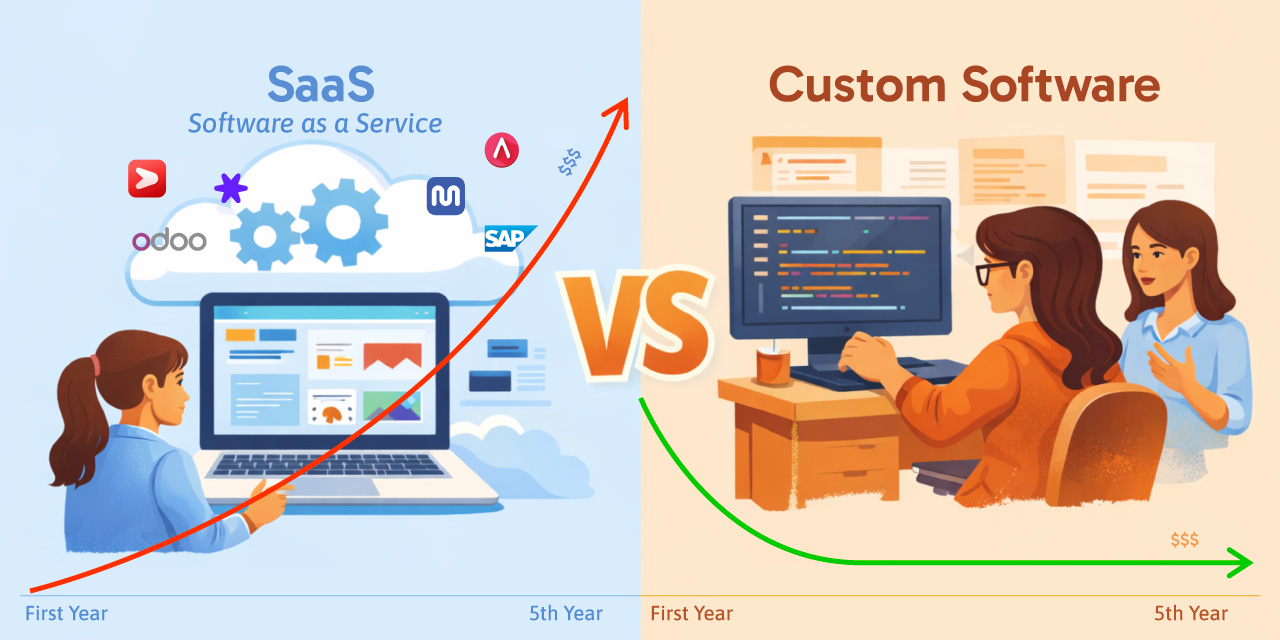
Almost every company today wants the same thing: to move faster, operate more efficiently, and scale with fewer headaches. And when a business starts investing seriously in digital systems, two options usually come up immediately:
Using SaaS (Software as a Service) — fast, ready-to-use, subscription-based.
Building Custom Software — designed specifically for the business.
Then comes the real question — not the “tech” question, but the business one: Which option is more profitable? And the honest answer is: it depends on your business stage, your workflows, and how unique your operations are. But there’s a pattern that shows up again and again:
SaaS wins in the short term. Custom software often wins in the long term.
Let’s be honest: SaaS is incredibly attractive. SaaS typically offers:
Konsultasi GRATIS tanpa Komitmen, dan temukan strategi terbaik untuk bisnis Anda.
CHAT SEKARANGfast implementation (days to weeks)
lower upfront cost
no need for an internal dev team
vendor-managed updates and maintenance
For many companies — especially those early in their digital transformation — SaaS is absolutely the right move. But SaaS has one characteristic most companies underestimate:
It often feels cheap at the beginning, but becomes expensive as your business grows.
fast go-live
lower initial cost
no need to build from scratch
maintenance and updates handled by the vendor
ideal for standard use cases
limited features based on subscription tiers
customization is often expensive or not available
integrations can be restricted
costs increase as user count grows
vendor dependency (pricing, roadmap, policies)
SaaS is like renting a ready-made house: comfortable, convenient… but you can’t freely renovate.
Custom software often feels like the heavier choice because:
upfront cost is higher
development takes time
you need a capable IT partner
But custom software offers something SaaS rarely can:
Custom software adapts to your business — instead of forcing your business to adapt to the software.
That’s what real flexibility looks like.
fully aligned with your business workflow
scalable and adaptable as your needs evolve
easier, deeper integrations
stronger data control and ownership
no per-user subscription costs that keep growing
becomes a long-term business asset
higher initial investment
longer implementation timeline
poor planning can lead to scope creep
requires maintenance (but usually predictable)
To avoid staying in theory, let’s use a simple cost simulation based on common benchmarks in Jakarta’s IT market. These are not exact prices from a specific vendor — but realistic ranges many mid-sized companies experience in Indonesia.
Scenario Assumptions
a mid-sized company
20 active users
needs standard features + a few integrations
the system will be used for at least 5 years
| SaaS (estimated monthly) | Custom Software (one-time) | ||
| Base license package | 5.000.000 | Development Fee | 400.000.000 |
| Premium feature add-ons | 2.000.000 | Annual Maintenance (around 10% of project value) | 40.000.000 |
| Additional users | 500.000/user | ||
Short-Term Cost: Year 1
| SaaS | Custom Software | ||
| Base License (5.000.000 x12) | 60.000.000 | Development Fee | 400.000.000 |
| Add-ons (2.000.000 x12) | 24.000.000 | Maintenance Fee | 40.000.000 |
| Users (500.000 x20 x12) | 120.000.000 | ||
| First Year Cost | 204.000.000 | First Year Cost | 440.000.000 |
Year 1 conclusion: SaaS is clearly cheaper and faster. And that’s why SaaS feels like the most profitable option at the beginning.
Long-Term Cost: 5 Years
Now let’s look at the bigger picture: total cost over time.
| SaaS | Custom Software | ||
| Base License (60.000.000 x5) | 300.000.000 | Development Fee | 400.000.000 |
| Add-ons (24.000.000 x5) | 120.000.000 | Maintenance Fee (40.000.000 x5) | 200.000.000 |
| Users (120.000.000 x5) | 600.000.000 | ||
| 5 Years Total Cost | 1.020.000.000 | 5 Years Total Cost | 600.000.000 |
In this simulation, custom software could save: IDR 420,000,000 (around 40%) over 5 years. Table below present you the Final Comparison: SaaS vs Custom (5 Years)
SaaS tends to be more profitable when:
your needs are still standard
you want a fast go-live
user count is still small
integrations are minimal
you want to validate your workflow first
Custom software tends to win when:
your workflow is unique
your user count keeps growing (SaaS cost rises)
you need multiple integrations
you want full control and ownership
you want the system to become a long-term business asset
Here’s the part that rarely shows up in spreadsheets:
Software that is hard to use becomes expensive — even if it looks cheap.
Because poor usability creates:
repeated training costs
low adoption
manual workarounds
higher error rates
productivity loss
✅ This is one reason custom software often delivers stronger ROI: because you can design the UI/UX around your actual users — not around generic market assumptions.
To summarize:
SaaS is profitable for speed and standard needs
Custom software is profitable for long-term growth and unique workflows
And as companies scale, one truth becomes clear:
Generic systems eventually stop feeling like solutions — and start feeling like compromises.
At Graphie, we build custom software that is not only technically strong, but also designed with tailor-made UI/UX — seamless, intuitive, and genuinely enjoyable to use. Because profitable software isn’t just software that exists… It’s software that your team actually uses every day.
If you’re ready to build a system that grows with your business, Graphie is here to help.

Recommended for you
The Hydrogen Fuel Frontier: Aryanto Misel's Nikuba Tech Shakes the World
The Best Power-Ups and Boosters in Ducky Pop: When and How to Use Them
The Psychology Behind Match-3 Games: Why Ducky Pop is So Addictive
AI Usage in Indonesia: What the Data Reveals About Adoption, Usage Patterns, and Integration Readiness
Feeding the Future: Tackling Global Food Security with AI Agriculture
Ducky Pop: A Splash in the Match-3 Pool
From Idea to Launch: A Step-by-Step Guide to Building Your Dream Startup
The Digital Revolution: How Mobile Apps Have Transformed Our Daily Lives
Ducky Pop: A Splash in the Match-3 Pool
Unlock the Hidden Worlds: Exploring the Different Themes and Levels in Ducky Pop
Tonework: The Future of Personalized Beauty is Here
Typography Tips That Wow: How to Use Fonts Like a Pro
The Future of Website Design: AI-Driven Tools Transforming User Experience
The Power of Data Analytics: How to Drive Growth with Informed Decisions
UI vs. UX: Cracking the Code of Digital Magic