

The Hydrogen Fuel Frontier: Aryanto Misel's Nikuba Tech Shakes the World
20 Sep, 2026
- 15820 views


2016 - 2026 Copyright @ Graphie.
All Rights Reserved
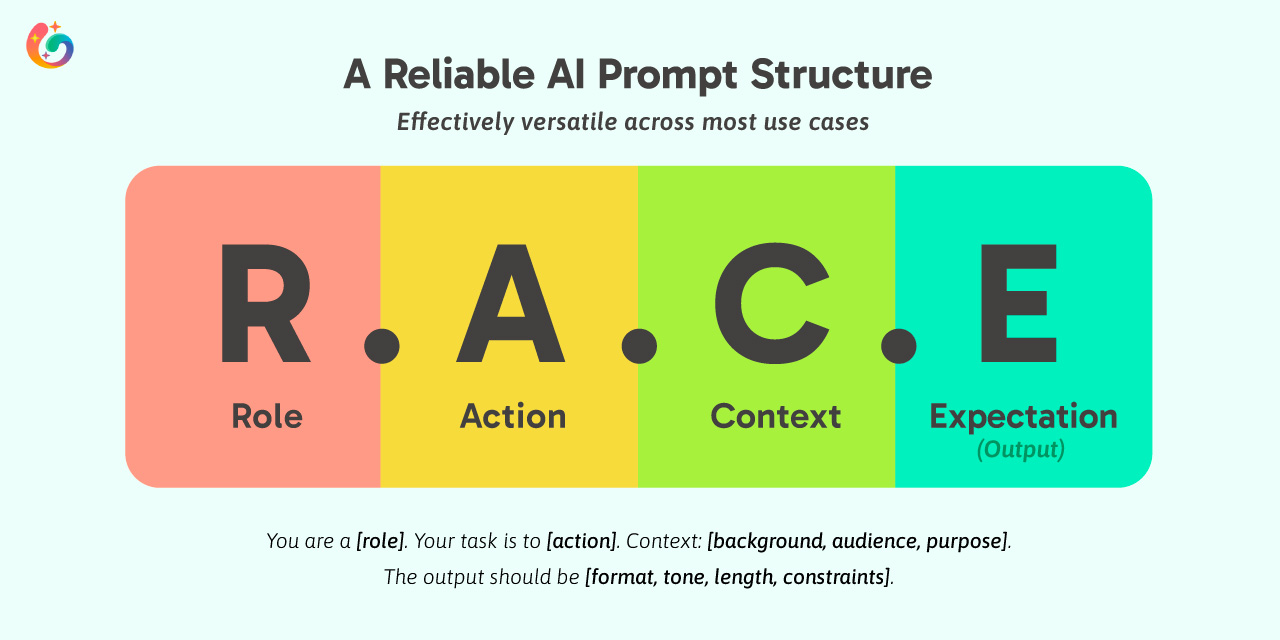
As AI becomes increasingly integrated into business, content creation, and decision-making processes, one key challenge remains: how to give AI clear and effective instructions. The solution is not about using “magic words,” but about applying a structured way of thinking.
This is where the R.A.C.E Prompt Framework proves its value.
R.A.C.E is a structured approach to writing prompts, built on four essential components:
R — Role
Define who the AI should act as.
A — Action
Clearly state the task the AI needs to perform.
C — Context
Provide background information such as audience, industry, or situation.
E — Expectation (Output)
Specify the desired output format, tone, length, and constraints.
This framework helps AI understand what to do, for whom, and how the result should be delivered.
Most ineffective AI outputs are not caused by weak AI capabilities, but by unclear or incomplete prompts. R.A.C.E forces clarity by structuring instructions logically, which results in:
Less misinterpretation
More consistent and relevant outputs
Reduced revision time
Better usability for both beginners and professionals
In essence, R.A.C.E is not just a prompt framework—it is a thinking framework.
Assigning a role shapes the AI’s perspective, language, and decision-making approach.
Examples:
Digital marketing strategist
UX consultant
Business analyst
Content writer
A clearly defined role helps AI respond with domain-specific insight rather than generic answers.
The action must be explicit and task-oriented.
Common actions include:
Write an article
Analyze a website
Generate ideas
Summarize information
Clear actions lead to focused and actionable results.
Context is often overlooked, yet it has a significant impact on output quality.
Context may include:
Target audience
Industry or market
Geographic focus
Business objectives
Without context, AI responses tend to remain general and less practical.
Expectation defines the standard of the final result.
This can include:
Word count or length
Tone (formal, professional, conversational)
Format (article, bullet points, table)
Specific constraints or rules
Clear expectations prevent results that are technically correct but not fit for purpose.
Unstructured prompt:
Write an article about soft selling.
R.A.C.E-based prompt:
Konsultasi GRATIS tanpa Komitmen, dan temukan strategi terbaik untuk bisnis Anda.
CHAT SEKARANGYou are a digital marketing strategist.
Write a blog article about soft selling in digital business.
The target audience is Indonesian SME owners.
The output should be 800 words, professional yet approachable, with headings and a subtle CTA.
The difference lies not in the topic, but in the clarity of instruction.
Yes. R.A.C.E is highly adaptable and effective across the majority of real-world AI applications, including:
Content creation
Business and market analysis
Idea generation
Marketing strategy
Technical documentation
Learning and education
Because R.A.C.E operates at the level of instruction structure, not task type, it remains reliable in almost any scenario.
R.A.C.E is more than a prompt format—it is a structured communication method between humans and AI. By applying this framework, users can:
Think more clearly
Communicate more precisely
Receive outputs that are practical, consistent, and ready to use
If you want dependable AI results without trial-and-error prompting, R.A.C.E is one of the safest and most effective frameworks to start with.


Recommended for you
The Hydrogen Fuel Frontier: Aryanto Misel's Nikuba Tech Shakes the World
The Best Power-Ups and Boosters in Ducky Pop: When and How to Use Them
The Psychology Behind Match-3 Games: Why Ducky Pop is So Addictive
AI Usage in Indonesia: What the Data Reveals About Adoption, Usage Patterns, and Integration Readiness
Feeding the Future: Tackling Global Food Security with AI Agriculture
Ducky Pop: A Splash in the Match-3 Pool
From Idea to Launch: A Step-by-Step Guide to Building Your Dream Startup
The Digital Revolution: How Mobile Apps Have Transformed Our Daily Lives
Ducky Pop: A Splash in the Match-3 Pool
Unlock the Hidden Worlds: Exploring the Different Themes and Levels in Ducky Pop
Tonework: The Future of Personalized Beauty is Here
Typography Tips That Wow: How to Use Fonts Like a Pro
The Future of Website Design: AI-Driven Tools Transforming User Experience
The Power of Data Analytics: How to Drive Growth with Informed Decisions
UI vs. UX: Cracking the Code of Digital Magic